
2026 Generic Congressional Ballot
Last updated: August 9, 2026
What is this?
This page tracks something polls usually don’t show: whether support is stable or fragile.
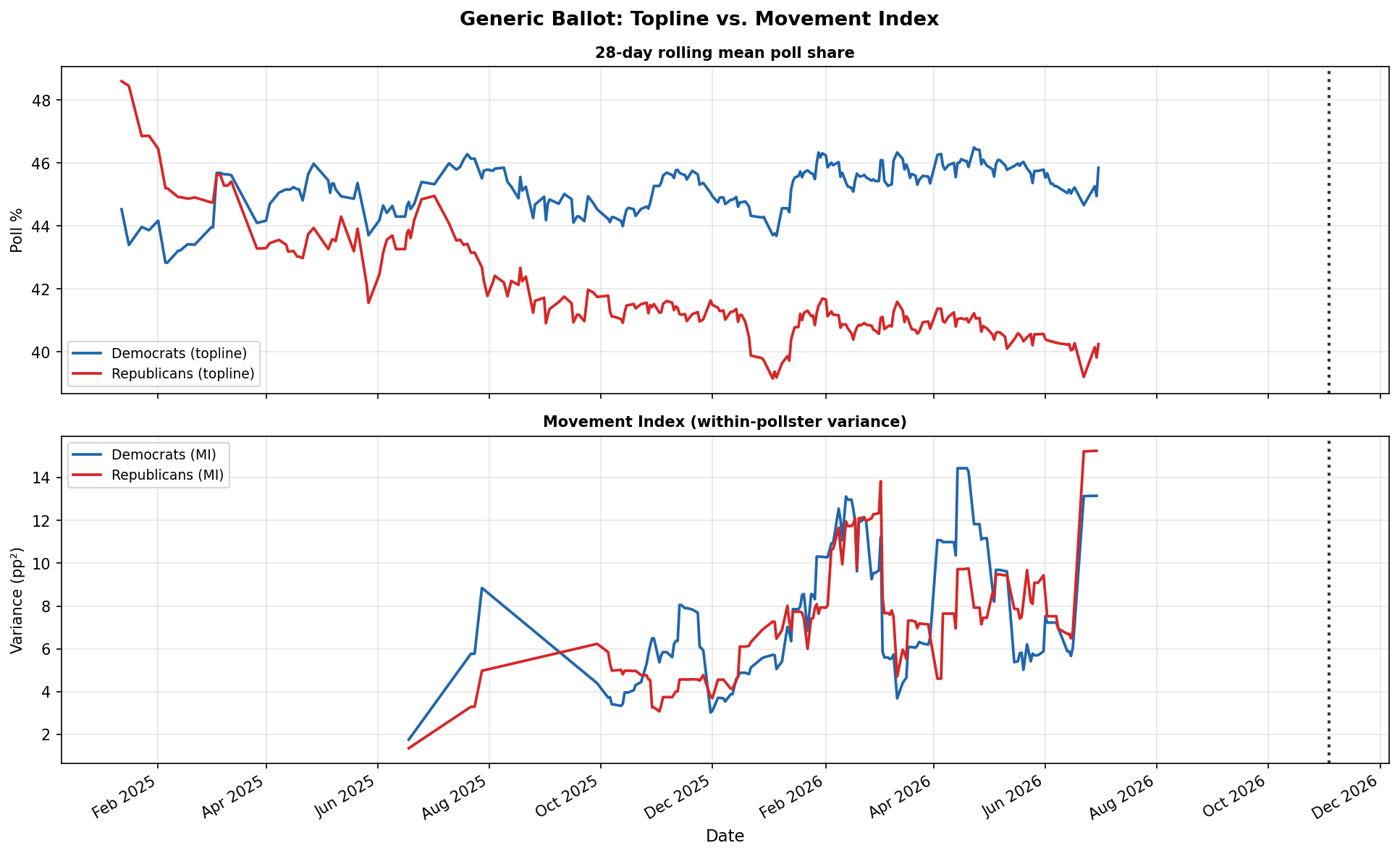
A party can lead in the average (e.g. Democrats +6) while individual pollsters are seeing their numbers move around underneath. This monitor separates real movement from pollster disagreement.
This is not a prediction of who will win. It’s a structural health check, updated as new polls come in.
How to read the charts
Blue = Democrats. Red = Republicans.
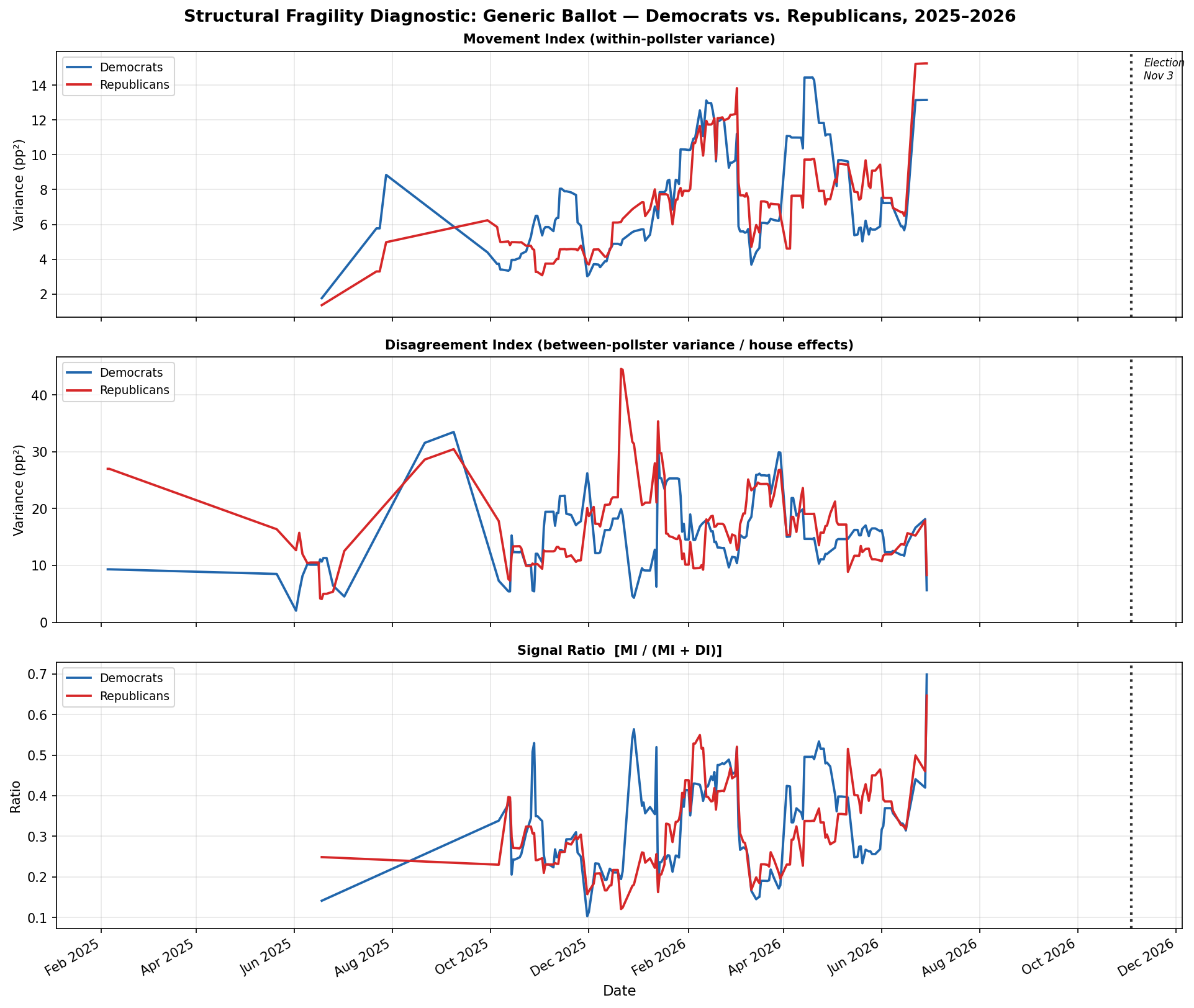
Top panel (Movement Index): Are each pollster’s own numbers jumping around? Higher = more instability.
Middle panel (Disagreement Index): Are pollsters disagreeing with each other? (Often methodology, not real shifts.)
Bottom panel (Signal Ratio): How much of the noise is real movement vs pollster disagreement?
If one side’s Movement Index rises while the average looks flat, that side may be structurally fragile — even when the topline doesn’t show it yet.
July snapshot: see analysis below the charts
Where things stand — August 9, 2026
The headline: Democrats still lead the generic congressional ballot by about five to six points in the latest available public polls. Aggregators show a similar race. This monitor asks: is that lead solid, or is something unstable underneath?
Structure (unchanged from last week’s MI read): Latest Movement Index date remains June 29, 2026 — VoteHub’s generic-ballot feed still has no July–August rows in this refresh.
Democrats: MI 13.2 pp² · Signal Ratio 0.70
Republicans: MI 15.3 pp² · Signal Ratio 0.65
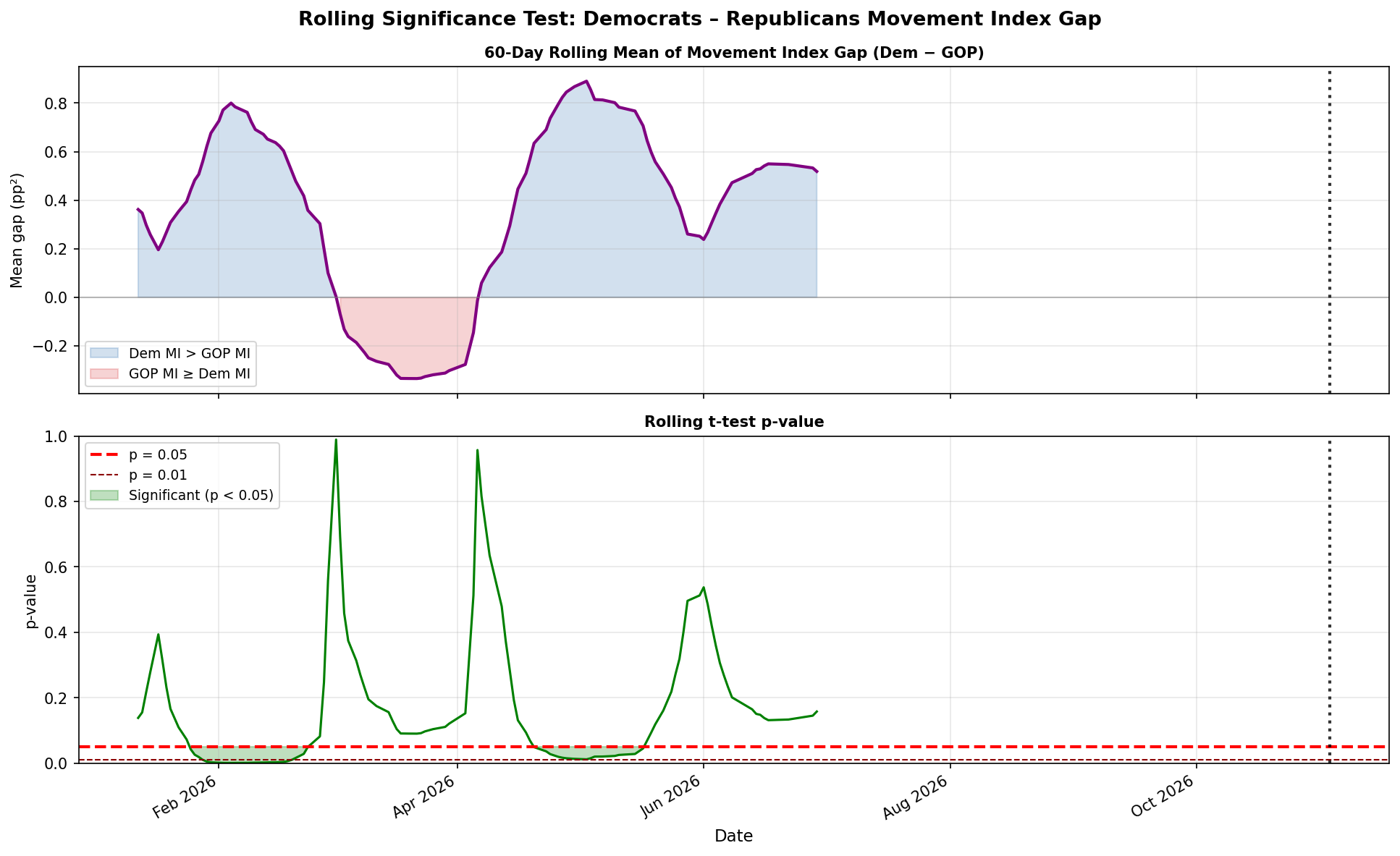
90-day Dem–GOP MI gap: not statistically significant (permutation p = 0.85)
What that means: Since early June, Democratic within-pollster volatility rose (Signal Ratio from ~0.37 to ~0.70). Both parties now sit above the 0.50 Signal Ratio line. That is a yellow flag for volatility on both sides — not a Biden-2024 pattern (flat average + sustained MI divergence from the opponent). The party gap itself is still noise-compatible.
What’s new this week is the Senate page, not the national MI: Texas and Maine now have enough public head-to-head polls to show topline charts. Movement Index for those races still needs repeated surveys from the same pollster (≥3 in a 28-day window) — no firm has cleared that bar yet.
Data caveat: National MI uses VoteHub through June 30. Texas Senate polls run into late July. We will refresh national MI as soon as midsummer generic-ballot volume appears in the feed.
Bottom line: National story holds — Dem lead in the average; elevated Signal Ratios on both sides; no confirmed Dem > GOP fragility gap. Senate monitors: Texas competitive with Talarico ahead in recent polls; Maine roughly tied; Kentucky still too thin for MI.
Kentucky Senate Race: Barr Vs. Booker
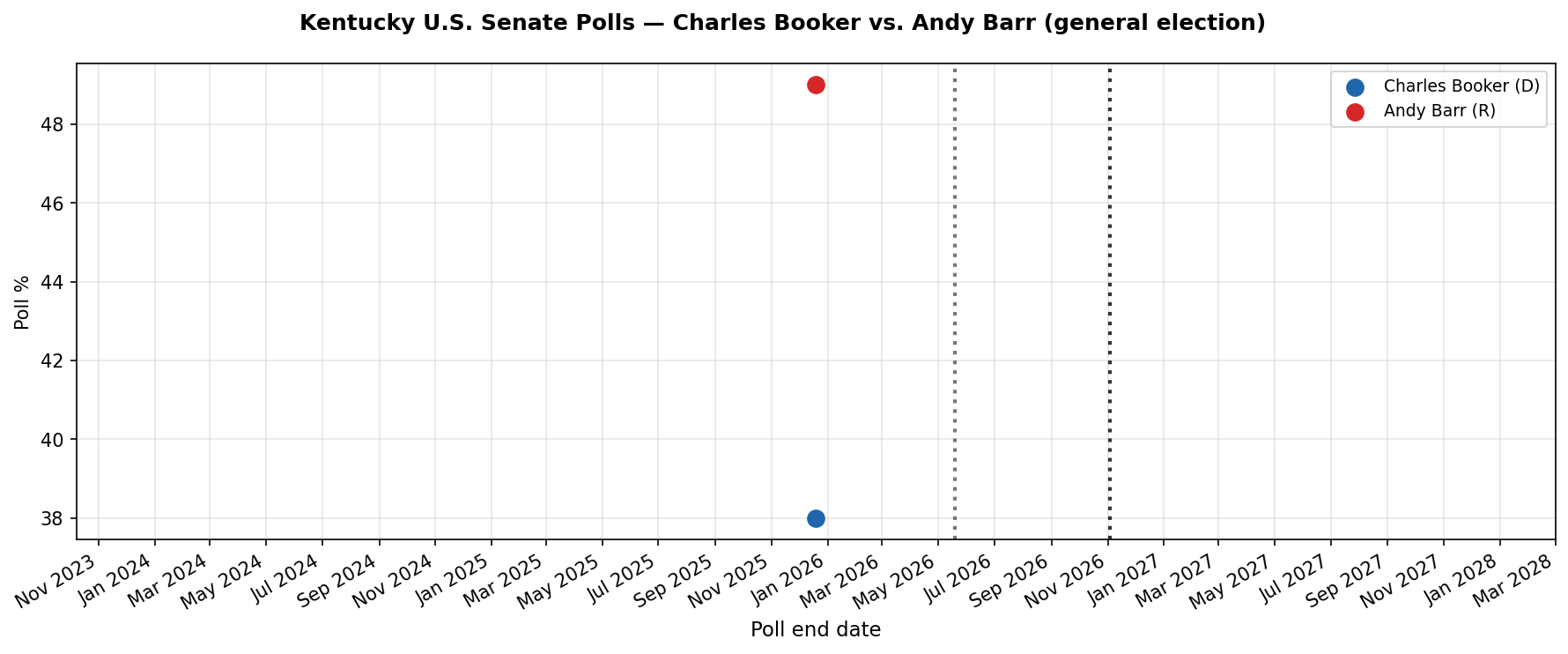
Kentucky U.S. Senate (Booker vs. Barr) — KY still one poll (Barr +11).
Texas Senate — Talarico vs. Paxton
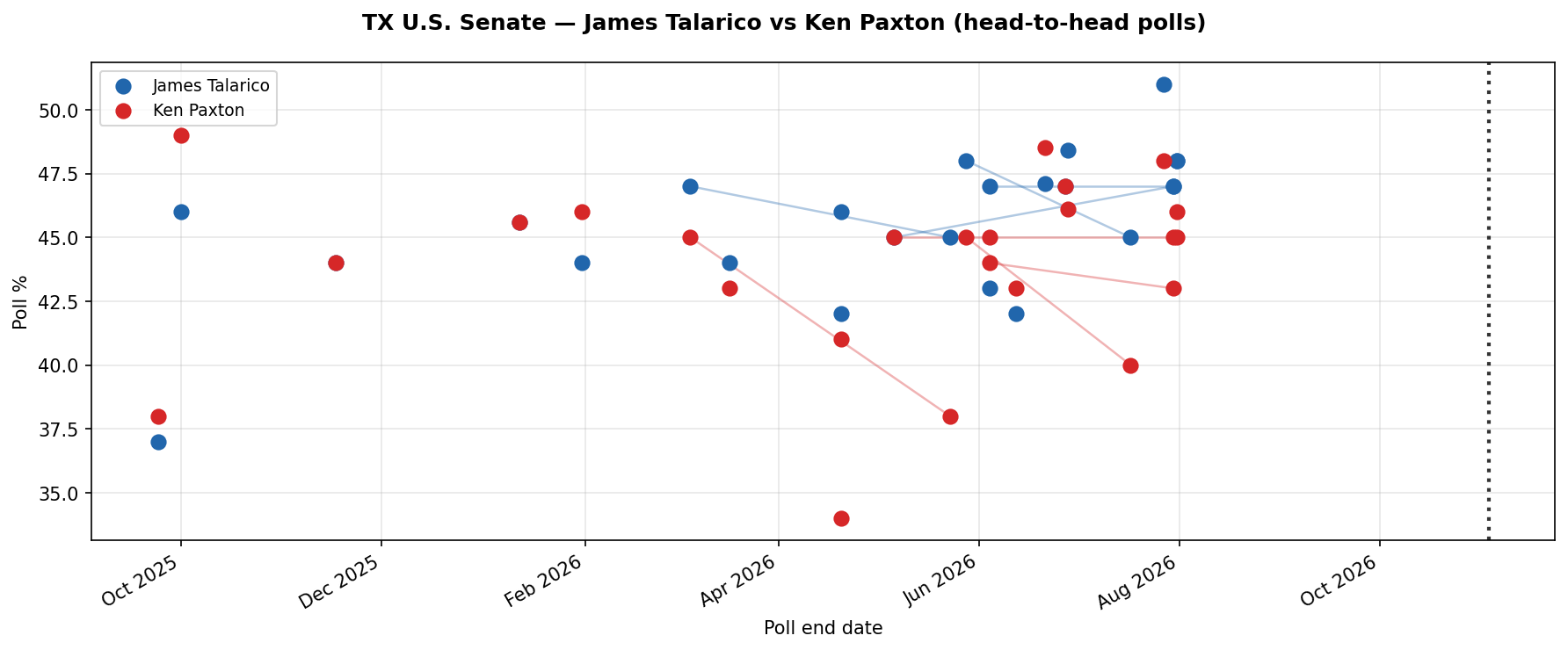
Texas U.S. Senate (Talarico vs. Paxton) — Public VoteHub matchups now show a competitive race with James Talarico ahead in recent averages — about 47.7% vs. Ken Paxton 44.5% over the last 28 days of available data (6 pollsters). Latest: Wedgewood Polls, July 31 — Talarico 48%, Paxton 46%. Late-July surveys (YouGov Blue, ReconMR/Siena, Beacon/Shaw, TSU) also show Talarico narrowly ahead or competitive..
Maine Senate — Jackson vs. Collins
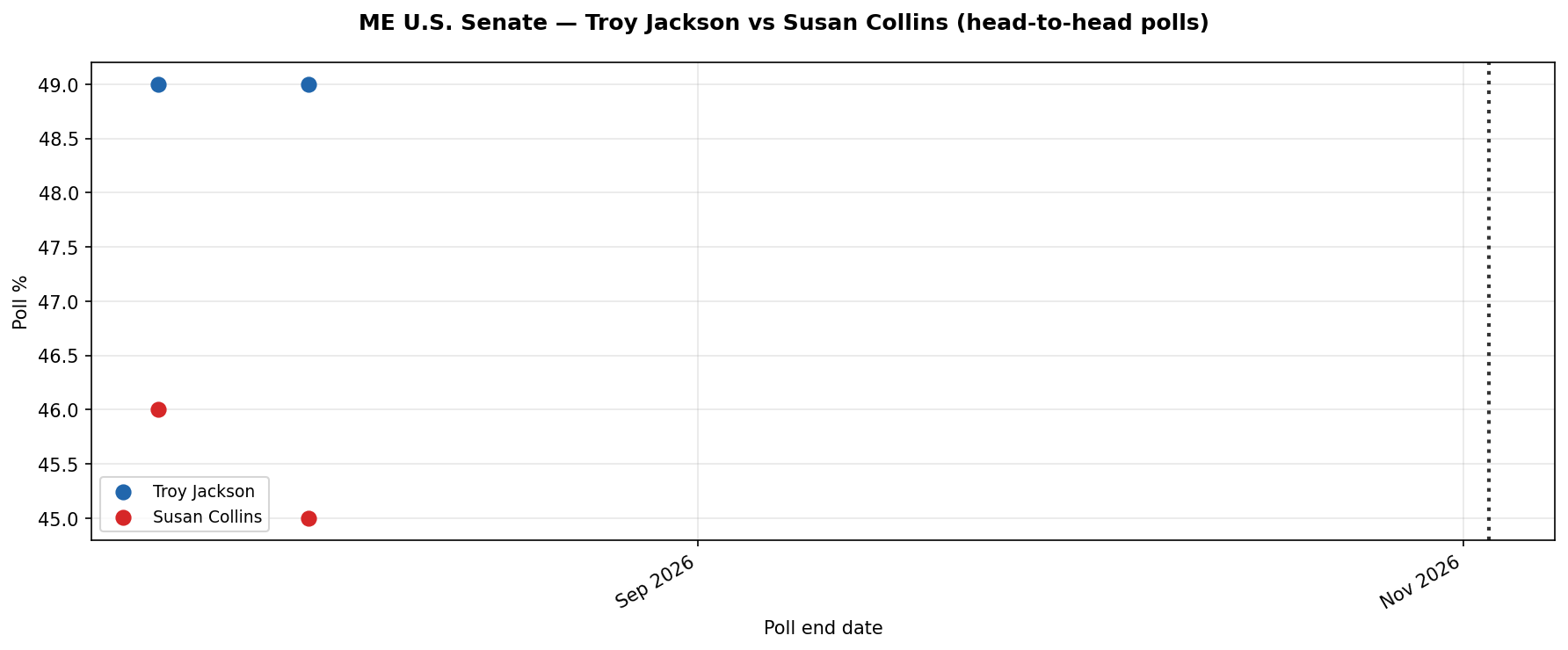
Maine U.S. Senate (Jackson vs. Collins) — Only two public head-to-head polls so far — Jackson ahead in both:
UNH, July 20: Jackson 49%, Collins 46%
Hart Research, Aug 1: Jackson 49%, Collins 45%.
Prospective preregistration
On June 14, 2026, I preregistered directional predictions for three 2026 U.S. Senate races on the Open Science Framework, using the within-pollster variance decomposition (Movement Index and Signal Ratio) — not conventional win-probability forecasts.
Preregistered races: Kentucky (Charles Booker vs Andy Barr), Texas (James Talarico vs Ken Paxton), Maine (Graham Platner vs Susan Collins).
What was specified in advance: For each race, whether one candidate would show elevated within-pollster variance (and, for Texas, sustained Signal Ratio thresholds), plus falsification criteria and minimum polling rules. Predictions were made before examining variance data for these races beyond topline averages.
Frozen registration: OSF preregistration (June 14, 2026) · Project: https://osf.io/k6c7b/
Weekly Senate briefings — Kentucky, Texas, Maine. Movement Index and fragility scorecard, updated every week as the 2026 cycle progresses.
Data: VoteHub Polling API (generic congressional ballot). Kentucky Senate: curated public polls (PPP, Emerson/FOX56); VoteHub when available. Method described in my paper on within-pollster variance decomposition: https://papers.ssrn.com/sol3/papers.cfm?abstract_id=6863938. Code and 2024 replication on GitHub (github.com/rstil2/polling-fragility).