Featured Projects: Innovation in Action


National Impact: Data Science Leadership for the White House
I played a pivotal role in the U.S. government’s response to the COVID-19 pandemic, leveraging data science and predictive modeling to drive large-scale, high-impact initiatives. As the Lead Data Scientist for the White House COVID-19 Home Test Kit Mission, I reported directly to senior leadership at the Department of Health and Human Services (HHS) and the White House.
In this role, I:
Built National Analytics Infrastructure: Developed and maintained the real-time dashboards used to monitor the distribution of hundreds of millions of test kits across the country.
Harnessed Enterprise Tech Stack: Utilized advanced big-data platforms like Palantir Foundry and the federal Tiberius tracking system to seamlessly link massive, disparate data streams—including live U.S. Census Bureau APIs—to provide immediate, actionable insights for decision-makers.
Prioritized Healthcare Equity: Embedded deep geographical mapping and social vulnerability indices into our models, ensuring life-saving resources were dynamically routed to the nation's most underserved communities.
Advised Top Federal Leadership: Translated highly complex data architectures into clear, data-driven strategic summaries for cabinet-level officials and White House staff to guide rapid decision-making during a national crisis.
Theoretical Unification: The Shared Math of Evolution and AI
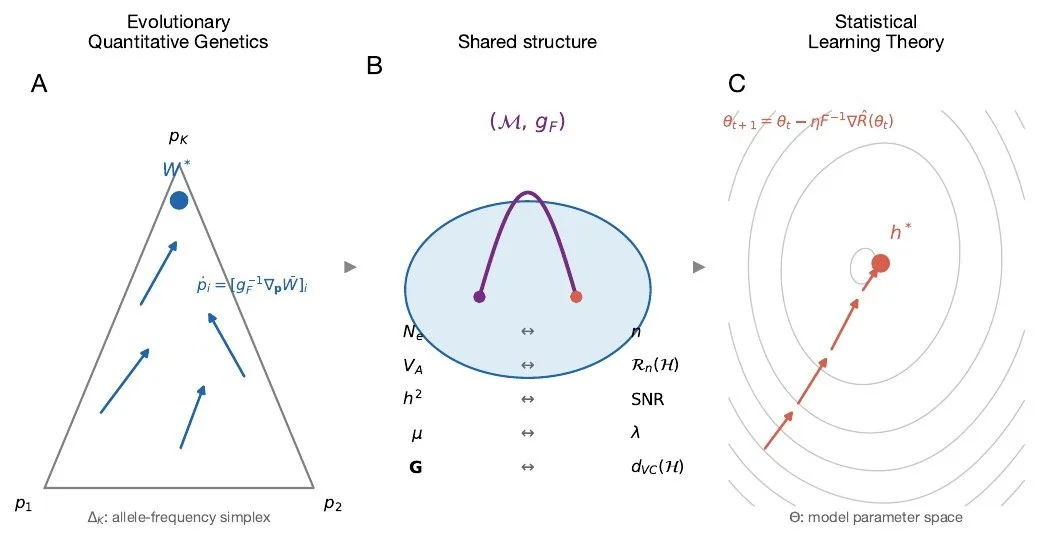
Natural selection and machine learning optimization are driven by the exact same mathematical laws. While scientific literature frequently relies on conceptual analogies to bridge complex adaptive systems and artificial intelligence, my latest framework moves past the metaphors to prove a formal structural isomorphism.
By mapping Empirical Risk Minimization (ERM) and natural selection to a shared information manifold, the mathematics demonstrate that they are the exact same optimization engine operating on different hardware. This isn't just a theoretical unification—it functions as a highly accurate predictive radar for the boundaries of adapting systems.
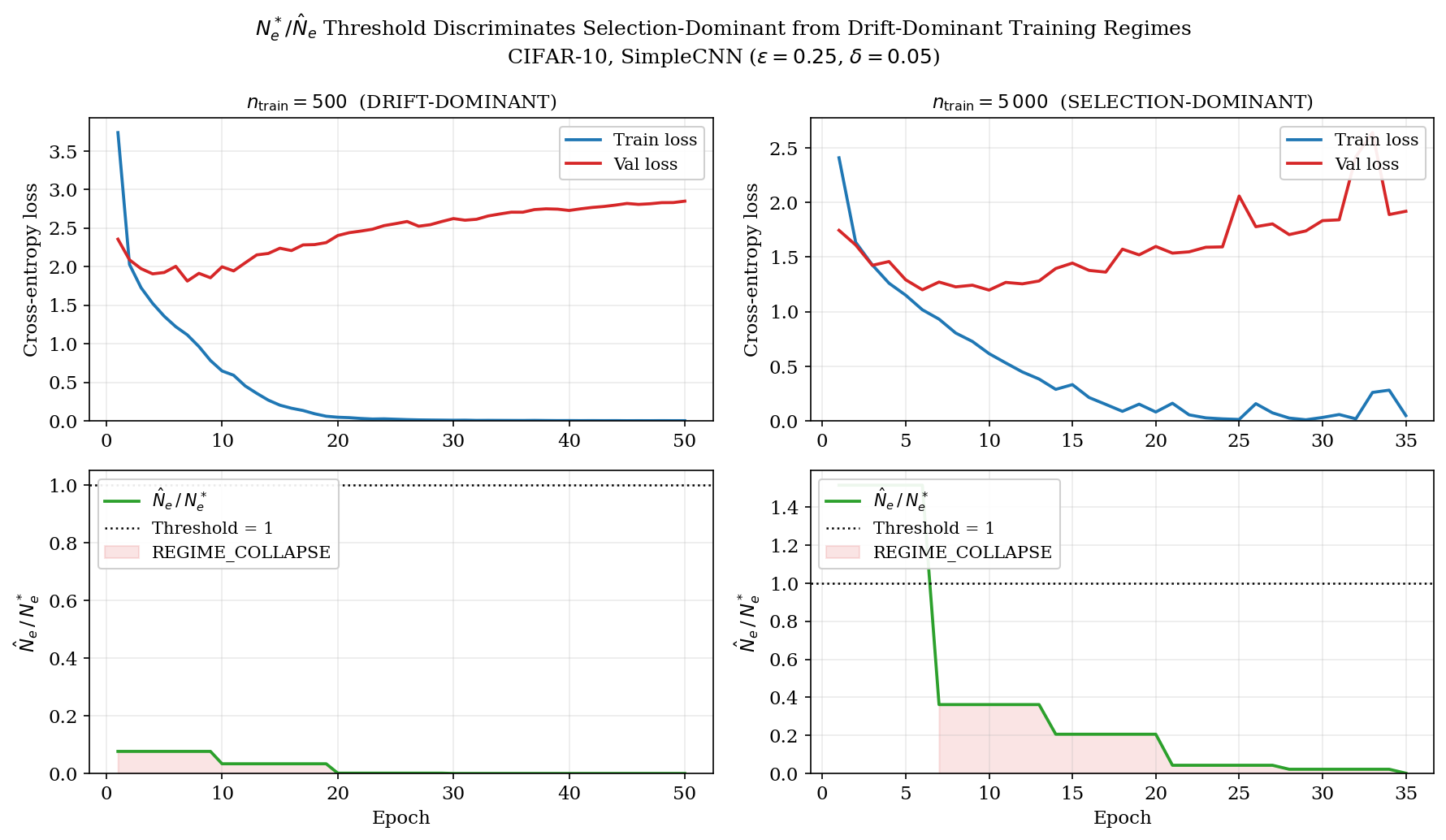
The Breakthrough: By applying this unified math, I derived a first-principles capacity threshold formula, Ne*, which calculates the exact stability and resistance limits of any adapting system.
The Validation: When stress-tested out-of-sample against deep learning benchmarks and clinical oncology datasets across nine distinct cancer types, this single formula successfully predicted both training collapse in deep networks and the exact temporal dynamics of subclonal drug resistance.
The Real-World Impact: The framework achieved a 96% empirical correlation (r = 0.96) in forecasting these critical breakdown thresholds across both biological and artificial systems.
Preprint here: https://www.researchsquare.com/article/rs-9848110/v1
AI Engineering: Agentic Workflows & Local LLM Optimization
As artificial intelligence shifts from passive text generation to autonomous execution, the bottleneck has moved from model size to architectural efficiency. My engineering work focuses on designing, optimizing, and deploying highly customized, local AI agents capable of automating complex technical workflows directly on specialized local hardware.
By bypassing cloud dependencies, this architecture maximizes data privacy, eliminates latency, and builds high-velocity programming and research ecosystems running entirely on local consumer silicon.
Advanced Tool Integration: Configured and optimized agentic AI platforms—including Cursor, Aider, and Open Interpreter—to interact directly with computer terminals, creating a hands-free environment for automated programming, script debugging, and document generation.
Hardware & BIOS Optimization: Architected and fine-tuned premium local hardware configurations (leveraging multi-core processors, high-capacity VRAM, and efficient thermal dissipation systems) to run high-quantization Large Language Models (LLMs) locally at maximum token-per-second performance.
Workflow Automation: Successfully automated the tedious pipelines of scientific research, linking local code execution with live data ingestion, enabling real-time data processing and automatic script adjustment without human intervention.
Production Security: Established a model for zero-trust data engineering, proving that elite-level AI assistance can be achieved on sensitive research data without exposing intellectual property to external cloud APIs.